


05 May 2026 12:07 UTC - by Andrew Ross Sorkin, Bernhard Warner, Sarah Kessler, Michael J. de la Merced, Niko Gallogly, Brian O’Keefe, Lauren Hirsch, Vivienne Walt
Behind the Trump Administration’s Potential Rethink on A.I.
➤ The article also touches upon other unrelated financial news, including market rebounds, crypto updates, and a tennis tech startup funding round.
➤ This potential policy change is driven by national security concerns, particularly regarding advanced AI models like Anthropic's Mythos and their cybersecurity implications.
➤ The Trump administration is considering a shift from a laissez-faire approach to AI regulation towards increased oversight, potentially including a government review process for new AI models.
You’re reading the DealBook newsletter. The most crucial business and policy news you need to know from Andrew Ross Sorkin and team.
Image
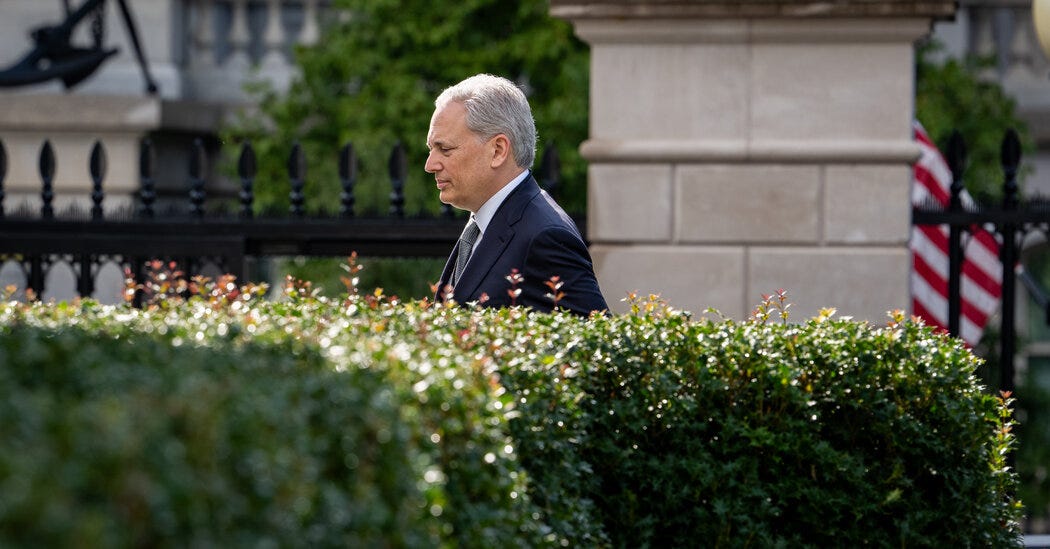
ImageIs the White House moving away from the laissez-faire approach to artificial intelligence championed by David Sacks, its former A.I. czar?Credit...Haiyun Jiang/The New York Times
Andrew here. Should there be the equivalent of the F.D.A. for artificial intelligence models? Should there be a government approval process before new models are released?
Those are some of the big questions as the White House weighs an executive order that could increase oversight of new A.I. tools. Will it need congressional approval? How much will the industry push back? More below.
The debate over new A.I. guardrails
For most of his second term, President Trump has embraced a laissez-faire approach to artificial intelligence. Let Silicon Valley do its thing, his administration reasoned, and it would maintain its lead over China and other rivals.
But a report by The Times about the White House potentially taking a heavier hand in overseeing A.I., including reviewing new models before they’re released, underscores how even the Trump administration has to reckon with how powerful these tools are becoming.
What’s being discussed: The administration is weighing the creation of a working group for government officials and industry leaders to discuss oversight procedures, The Times reports. Crucially, that may include a formal government review process for new A.I. models. (It may not involve actually blocking their release.)
A possible model is what Britain does, with government officials ensuring that A.I. meets certain safety standards.
It’s part of a shift in the White House’s thinking on A.I.:
• Until March, the administration’s point person on A.I. policy was David Sacks, a venture capitalist who has long favored a light regulatory touch. Sacks also openly feuded with Anthropic, which he has derided as “woke.”
• But Sacks is no longer in government (though he remains a tech adviser). Assuming bigger roles on the administration’s A.I. policies are Susie Wiles, the White House chief of staff, and Treasury Secretary Scott Bessent. Both met with Anthropic’s C.E.O., Dario Amodei, last month to discuss resuming the government’s use of its A.I. tools.
• Possibly on the table is re-empowering the Center for A.I. Standards and Innovation, a Biden-era agency meant to vet A.I. models, The Times adds.
Driving much of the shift is Mythos, Anthropic’s next-generation A.I. model, whose ability to rapidly find cybersecurity vulnerabilities has worried government and corporate leaders.
The White House has opposed letting Anthropic drastically increase access to Mythos, which is currently limited to several dozen companies and organizations. That’s in part because of fears of Mythos falling into the wrong hands (and in part because of fears that Anthropic may have to throttle use of the model given its computing resource constraints).
All that underscores how A.I. is increasingly a national security concern — and could create new geopoliticaltensions.
Mythos is only the first of many. OpenAI is also planning a limited release of its latest model, GPT-5.5-Cyber, because of similar concerns about cybersecurity. Amodei has predicted that other bleeding-edge tools will catch up within months.
• In other A.I. news: OpenAI weighed spinning out its robotics and consumer hardware divisions to give them more financial independence but has since soured on the idea, according to The Wall Street Journal.
Image
HERE’S WHAT’S HAPPENING
Global markets rebound as the cease-fire with Iran holds. Brent crude, the international benchmark for oil, fell below $113 this morning after clashes on Monday between U.S. and Iranian forces didn’t lead to a re-escalation in fighting. Still, analysts at Goldman Sachs warned, the world’s oil reserves are drawing down at a “concerning” pace, and the average price of U.S. gasoline rose again, to $4.48 a gallon, according to AAA.
Elon Musk’s lawyers grill the president of OpenAI on the stand. Greg Brockman, the OpenAI executive, faced tough questions from Musk’s legal team on Monday about whether his work was driven by greed. In other Musk legal news: The tech billionaire agreed to pay $1.5 million to settle a fight with the S.E.C. over whether he broke securities laws in his 2022 takeover of Twitter.
Shares in Intel rise on a report about potential deals with Apple. The chipmaker has held talks with Apple about making processors in the U.S. for the iPhone maker’s devices, according to Bloomberg. (Samsung has, too.) The possible plan lifted Intel’s stock about 3.6 percent in premarket trading on Tuesday.
Image
Renewed faith in crypto?
Since late last year, cryptocurrencies have had a rough time, with the price of Bitcoin having tumbling as low as $62,000, down from over $124,000 in October. The steep drop drew concerns that the shine had come off the sector.
But there are signs of encouragement in the crypto industry, and one of the sector’s biggest boosters has just announced that it still believes there is plenty of money to be made from digital currencies.
Image
Bitcoin is currently trading around $81,000, putting it up more than 20 percent month over month. Its strong performance in April set it up for its first monthly double-digit increase since May 2025.
That appears to be driven by a couple of factors, including:
• Coinbase, a big crypto exchange, signaled that it backed revisions to a major crypto bill known as the Clarity Act. At issue were adjustments to how interestlike payouts tied to stablecoins, known as rewards, would be regulated. Its shares rose in premarket trading this morning after the company announced layoffs.
• Until recently, hopes that the war in the Middle East would end soon had bolstered crypto prices, which tend to be sensitive to geopolitical risks.
• Strategy, the former tech company that is now basically a big bet on Bitcoin, has continued to spend hundreds of millions of dollars buying the digital token. (That said, it paused purchases this week.)
The crypto rally is reinvigorating some of the bullish talk that has come to define some of the industry. On Monday, Thomas Lee, the chairman of the Ethereum treasury firm Bitmine, claimed that a “crypto spring” was underway.
Andreessen Horowitz has just announced it’s still betting big on crypto. The venture capital giant said it had raised $2.2 billion for its fifth fund focused on the industry, bringing its total committed capital for the strategy to $9.8 billion.
In a blog post announcing the fund, executives at a16z, as the firm is known, noted that stablecoin use had kept growing even as trading volumes whipsawed. So, too, has the adoption of blockchains.
Those back-end technologies, they say, point to crypto’s durability.
What’s next for a Gulf oil giant
When the United Arab Emirates said last week that it would split from OPEC, many experts were surprised that it had taken so long, given the country’s differences with Saudi Arabia.
Now the oil powerhouse looks poised to take advantage of its newly independent status, pursuing a bold financial strategy that could redraw the balance of power in the region, Vivienne Walt writes.
The Emirates wants to be a hub for deal makers and business. Despite a shaky cease-fire in the war in Iran — and a drone attack on Monday on the Emirati oil port of Fujairah — thousands of investors and executives descended on Abu Dhabi’s convention center on Monday for the opening of the trade show Make it in the Emirates.
After canceling a string of events earlier this spring, the country was determined to get back to business. Officials announced record attendance for the event.
The Emirates has a new sales pitch: becoming a manufacturing hub, Sultan Ahmed Al Jaber, the country’s minister of industry and advanced technology, told attendees on Mondayon Monday.
He also leads the state-run oil company known as Adnoc, which announced on Sunday a $150 billion five-year plan to expand energy infrastructure, even as the war batters oil and gas exports.
Artificial intelligence is a huge focus. In recent years, the Emirates struck A.I. infrastructure deals with OpenAI, Microsoft and others. With about $2 trillion in its sovereign wealth funds, the nation is viewed as a deep-pocketed partner for tech companies.
The country’s plan after the war in Iran winds down is to double down on economic sovereignty, industrial resilience and technology, Kristian Alexander, a senior fellow at Rabdan Security and Defense Institute in Abu Dhabi, told DealBook.
A sense of urgency is driving the Emirates’ diversification strategy. Underpinning it is the belief that global demand for oil will decline around midcentury as the green transition takes hold.
Last week, Abu Dhabi announced it would increase oil production to five million barrels per day, from about 3.2 million barrels, as soon as next year.
ImageCredit...Angela Weiss/Agence France-Presse — Getty Images
Picture of the day
Last night’s Met Gala brought together celebrities and business moguls alike at the Metropolitan Museum of Art in New York City, complete with head-turning high-design looks.
But the event drew more scrutiny than usual this year given that two of its lead sponsors were Jeff Bezos and Lauren Sánchez Bezos. (Lauren Sánchez Bezos is pictured here with her fellow co-chairs of the gala, Nicole Kidman and Anna Wintour.)
Jeff Bezos skipped the red carpet, as did a fellow tech mogul and attendee, Mark Zuckerberg.
A tennis tech start-up scores funding
PlayReplay, an electronic line-calling company backed by the U.S. Tennis Association, just raised $12 million in a round led by Alfven & Didrikson, alongside Centre Court Capital, a fund managed by LionTree, ExM Investment Partners and others, Lauren Hirsch is the first to report.
The start-up was the first company to receive backing from the U.S.T.A.’s venture fund, which started in 2023. The U.S.T.A., which did not participate in this round, announced last week that all men’s and women’s hard court tournaments on its entry-level circuit, the International Tennis Federation’s World Tennis Tour tournaments, are using the technology.
Electronic line judges can be costly. The I.T.F. requires that elite tournaments, like the U.S. Open and Wimbledon, only use line-calling technology that meets its gold standard. But such technology is expensive: Hawk-Eye, which is used at Grand Slam events, costs nearly $100,000 to set up for one court.
By contrast, PlayReplay, whose technology has gotten the silver status required by the International Tennis Federation for second-tier tournaments, costs about $3,500 per indoor court per year.
PlayReplay wants to bring its technology to the masses. The system uses four cameras for each court. (Hawk-Eye, by comparison, uses about 12 cameras, which are also much larger, per court.) The cameras use 3-D tracking and artificial intelligence to monitor the players, court and ball. A courtside screen offers real-time data. Players can also use a mobile app to track data, such as player statistics and performance across matches.
“We would love to see the scale of use of it in all kinds of tennis clubs around the United States,” Michael Hughes Sr., the director of digital strategy and business innovation at the U.S.T.A., told DealBook.
PlayReplay, based in Stockholm, has partnerships with Tennis Canada and the German Tennis Federation, as well as a three-year exclusive relationship with the Intercollegiate Tennis Associate.
In addition to scaling, PlayReplay will use the funds to move into other racket sports, its C.E.O., Hans Lundstam, said. Its technology is already being used in pro pickleball, and the start-up has its eye on padel and badminton.
Image
THE SPEED READ
Deals
• Shares in GameStop sank on Monday as investors digested its surprise $55.5 billion takeover bid for eBay — and its C.E.O.’s strange interview with CNBC. (CNBC)
• Sierra, a start-up focused on artificial intelligence agents for customer service, raised $950 million at a valuation above $15 billion. (TechCrunch)
Politics, policy and regulation
• Jeanine Pirro, the U.S. attorney for Washington, dropped efforts to appeal a court ruling that quashed subpoenas for the Fed over the renovation of its headquarters. (CNBC)
• “The Billionaire Donors Behind Trump’s Midterm Superweapon” (Forbes)
Best of the rest
• “Why Almost Everyone Loses — Except a Few Sharks — on Prediction Markets” (WSJ)
• Doris Fisher, who founded the Gap with her husband and created a retail empire, died on Saturday. She was 94. (NYT)
• The legal battle over “It Ends With Us,” which involved the actors Blake Lively and Justin Baldoni, texts with Taylor Swift, allegations of a smear campaign and more, has ended. (NYT)
Image
We’d like your feedback! Please email thoughts and suggestions to dealbook@nytimes.com.
Andrew Ross Sorkin is a columnist and the founder of DealBook, the flagship business and policy newsletter at The Times and an annual conference.
Bernhard Warner is a senior editor for DealBook, a newsletter from The Times, covering business trends, the economy and the markets.
Niko Gallogly is a Times reporter, covering business for the DealBook newsletter.
Brian O'Keefe is the managing editor of DealBook, a newsletter from The New York Times that covers business, policy and culture — and the many ways they overlap.
Lauren Hirsch is a Times reporter who covers deals and dealmakers in Wall Street and Washington.
The Times Sale is on.
$0.25/week for your first six months year.
Subscribe
Categories rationale: The article primarily discusses the potential for increased government regulation and oversight of Artificial Intelligence, which falls under 'Legal & Regulatory Framework' (Level 1) and specifically 'Securities Law & Asset Classification' (Level 2) due to the nature of AI models being considered for regulation. It also heavily features 'AI & Automation' (Level 1) with a focus on 'Automated Compliance & Reporting' and 'Process Automation' (Level 2) as these are directly related to how AI itself is being developed and potentially regulated.Characteristics justification: The article discusses a potential shift in policy, indicating uncertainty about future regulatory actions ('uncertainty': 0.9). While the overall tone is informative, the discussion of national security concerns and potential pushback from the industry introduces a slight negative undertone ('sentiment': 0.2). The topic of AI regulation is evolving rapidly, suggesting a moderate level of novelty ('entropy': 0.75). The article is timely and relevant to current policy discussions ('relevance': 0.8).Tag relevance: The selected tags represent the core themes of the article: 'artificial intelligence', 'ai regulation', 'white house', 'trump administration', 'national security', 'oversight', 'executive order', 'anthropic', 'mythos', and 'cybersecurity'. These terms are central to understanding the main discussion points and the entities involved.asset-types: others
rwa: false
entropy: 0.75
sentiment: 0.2
staleness: 0.3
relevance: 0.8
uncertainty: 0.9RWATimes slug: nytimes-behind-the-trump-administrations-potential-rethink-on-a-i-408688332