

Ethereum's Evolving Token Utility and Its Implications for Long-Term Value: Assessing the Risks and Opportunities in a Rollup-Centric Ecosystem

01 Jan 2026 08:52 UTC - by Adrian Sava
Ethereum's Evolving Token Utility and Its Implications for Long-Term Value: Assessing the Risks and Opportunities in a Rollup-Centric Ecosystem
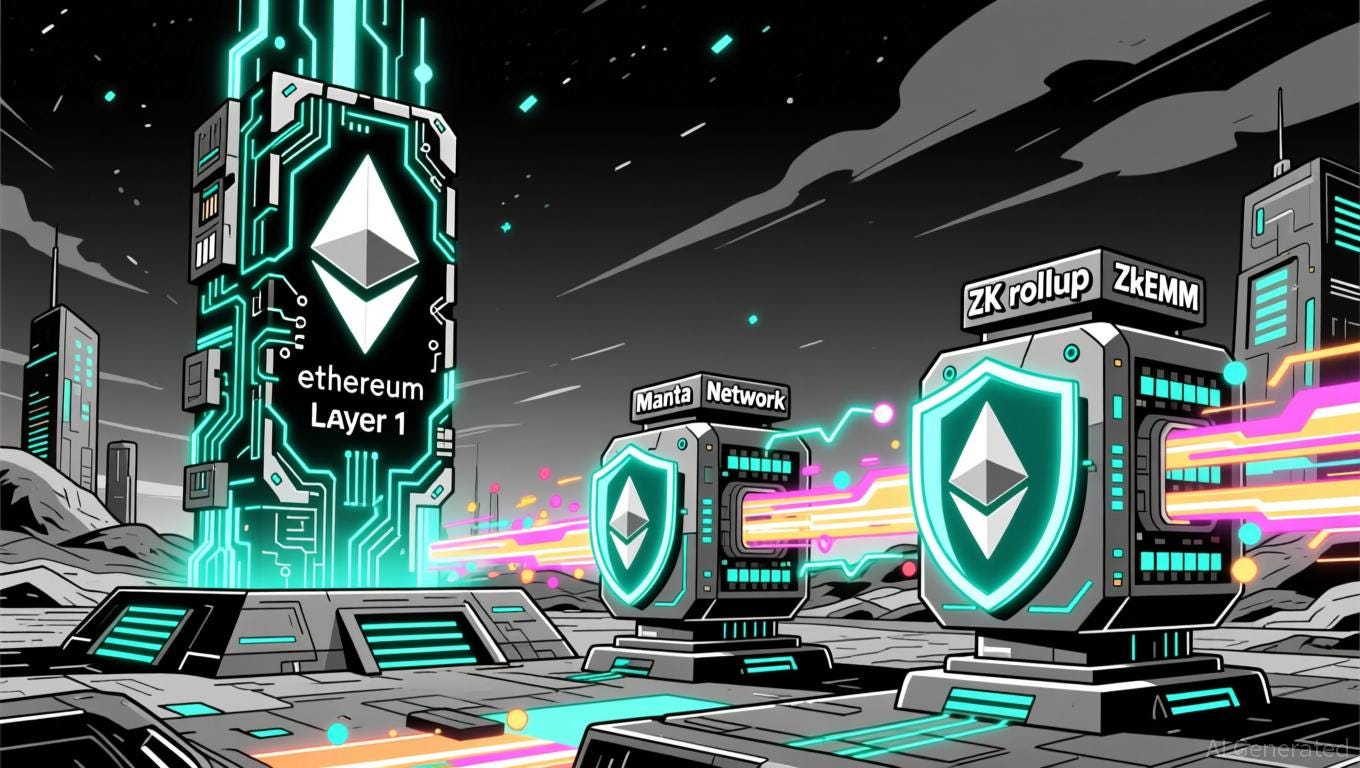
Ethereum's post-Merge transformation has redefined its token utility, positioning
as both a deflationary asset and a foundational layer for decentralized finance (DeFi) and real-world asset (RWA) tokenization. As the ecosystem shifts toward a rollup-centric model, the interplay between Layer 2 scalability solutions and Ethereum's core infrastructure is reshaping demand dynamics, institutional adoption, and long-term value. However, this evolution is not without risks.
The Rollup Revolution: Expanding Ethereum's Economic Footprint
Zero-Knowledge (ZK) rollups have emerged as the dominant scaling solution,
while maintaining security guarantees through cryptographic proofs. Projects like
,
,and Polygon zkEVM have driven adoption by reducing gas fees and enhancing privacy, creating a feedback loop where
on Ethereum's Layer 1. This dynamic has elevated ETH's role as a settlement currency, with transaction volume distribution shifting toward rollups while Layer 1 captures a growing share of fees.
The economic implications are profound. As ZK rollups scale, they amplify Ethereum's "transactional gravity,"
on a network where ETH's scarcity and utility are increasingly intertwined. This aligns with Ethereum's post-Merge deflationary mechanics, where issuance rates have declined, and demand from staking and settlement activity has outpaced supply, creating a structural tailwind for ETH's value.
Institutional Adoption: as Global Financial Infrastructure
Ethereum's institutional adoption in 2025 has been fueled by its role in tokenizing real-world assets (RWAs) and its energy-efficient proof-of-stake consensus.
,55% of the tokenized asset market operates on Ethereum, spanning U.S. Treasuries, real estate, and commodities. Standards like ERC-3643 and ERC-1400 embed compliance-first features, enabling institutions to tokenize assets with built-in KYC/AML controls.
of the tokenized Treasury market, leveraging Ethereum's programmability to create liquid, tradable assets.
Institutional confidence has also been bolstered by Ethereum's energy efficiency,
,addressing ESG concerns that previously hindered adoption. Coupled with the approval of Ethereum spot ETFs and custody solutions from firms like BNY Mellon, Ethereum is no longer viewed as a speculative asset but as a legitimate infrastructure layer for institutional-grade financial applications.
Risks in the Rollup-Centric Ecosystem
Despite these opportunities, Ethereum's rollup-centric model introduces new risks. ZK rollups, while theoretically secure, face technical challenges in scaling complex use cases. Computational intensity in generating validity proofs remains a bottleneck, and
or data availability-could undermine decentralization. While projects like
Era aim to address these issues, implementation errors or vulnerabilities in smart contracts could expose users to losses.
Regulatory uncertainties further complicate the landscape. As tokenized RWAs expand, frameworks for compliance, tax treatment, and investor protection remain fragmented.
will be critical to sustaining growth, particularly as institutions seek to integrate Ethereum-based assets into traditional portfolios.
Balancing Innovation and Caution
Ethereum's long-term value hinges on its ability to balance innovation with risk mitigation. The rollup-centric model has unlocked unprecedented scalability and institutional access, but technical and regulatory challenges must be addressed to preserve decentralization and security. For investors, Ethereum's dual role as a deflationary asset and a programmable infrastructure layer offers compelling upside, provided that developers and policymakers continue to prioritize robustness and compliance.
As the ecosystem evolves, Ethereum's success will depend not only on its technological execution but also on its capacity to adapt to a rapidly changing financial landscape. For now, the data suggests that Ethereum's token utility is not just surviving the post-Merge transition-it is thriving.
Read Original ArticleCategories rationale: The article primarily discusses Ethereum's technological evolution (Layer 2 scaling via ZK-rollups), which falls under blockchain-usage (specifically L2 solutions). A major theme is the resulting institutional adoption driven by RWA tokenization. The specific RWA asset mentioned most prominently is U.S. Treasuries, classifying it under asset-types (Financial Instruments).Characteristics justification: The tone is largely positive, highlighting 'thriving' utility, 'profound' economic implications, and 'compelling upside' due to scalability and institutional confidence (e.g., ETF approvals). However, there is significant uncertainty (0.7) flagged by discussing 'new risks,' 'technical challenges,' and 'regulatory uncertainties' regarding compliance and smart contract vulnerabilities.Tag relevance: Tags focus on the core technology (Ethereum, ZK-rollups), the compliance standards enabling institutional use (ERC-3643, ERC-1400), the primary asset class discussed (US Treasuries), and the overarching themes of institutional adoption and DeFi integration.asset-types: treasury
rwa: true
entropy: 0.65
sentiment: 0.4
staleness: 0.2
relevance: 0.9
uncertainty: 0.7