


03 Jun 2026 15:58 UTC
Five Things to Know About Colleges Reinstating the SAT - WSJ
➤ Elite institutions like Yale, MIT, and Dartmouth are tightening entrance exam policies as average SAT scores have fallen.
➤ Test performance is declining, with fewer students meeting math and reading benchmarks, while high school GPAs are rising, weakening their predictive power.
➤ Many colleges are reinstating SAT/ACT requirements after a pandemic-era shift to test-optional policies, with some students still submitting scores.
June 3, 2026 9:45 am ET
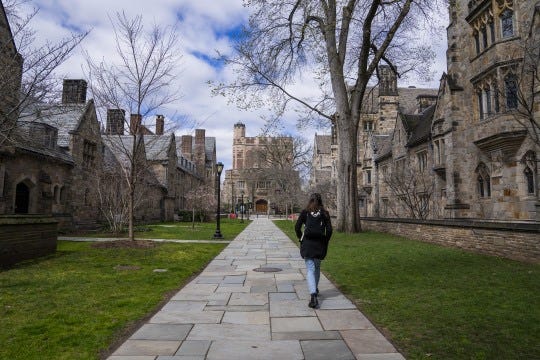
Yale University in New Haven, Conn.Joe Buglewicz/Bloomberg
After a pandemic-era push to stop requiring standardized tests like the SAT and ACT, some schools are bringing them back. Others are under pressure to do so. Here are five things to know about what’s happening with the SATs.
Most schools are test-optional, but lots of students still take the SAT
For years, the SAT was the gold standard of college-admission exams. Today, about 90% of colleges don’t require the SAT or ACT, according to FairTest, which advocates against the exams.
Even though most schools don’t require them, admissions officers often use submitted scores to assess candidates. The number of people taking the SAT has risen in recent years.
Created with Highcharts 9.0.1SAT total test-takersSource: College Board
Created with Highcharts 9.0.12021'22'23'24'25012 million
Test performance is falling
Fewer high-school students are meeting the SAT’s math and reading benchmarks. Last year fewer than 40% of test-takers met the benchmarks, which are supposed to predict whether someone has a 75% chance of getting at least a C in a first-semester, college-level math, writing or history course.
Created with Highcharts 9.0.1Students that met benchmarks for math and readingSource: College Board
Created with Highcharts 9.0.12021'22'23'24'2502550%
High school grade inflation has risen
Test-requirement advocates say standardized exams have become a more-important evaluation tool because GPA has become less useful. High school GPAs were rising even before the pandemic, weakening their power to predict an applicant’s success in college.
Created with Highcharts 9.0.1Cumulative High School GPASource: ACT
Created with Highcharts 9.0.12010'12'14'16'18'20'213.03.13.23.33.43.5
Elite schools are tightening entrance-exam policies
Yale recently announced it would require an SAT or ACT score after several years of a more flexible policy. MIT and Dartmouth have also reinstated test mandates in recent years. At the University of California, hundreds of professors wrote a letter last week urging the UC regents to reinstate entrance-exam requirements.
SAT scores have declined
These moves come as average SAT scores have fallen.
Created with Highcharts 9.0.1SAT mean scoreSource: College Board
Created with Highcharts 9.0.12021'22'23'24'25900950100010501100
Copyright ©2026 Dow Jones & Company, Inc. All Rights Reserved. 87990cbe856818d5eddac44c7b1cdeb8
Carl Churchill is a graphics reporter with The Wall Street Journal. He works primarily on issues relating to climate, ecology, and U.S. news. He joined the Journal after working for Woodwell Climate Research Center, a climate science organization based in Massachusetts. While there, he received recognition for his graphics work on Amazon deforestation and Arctic climate change. He has a master's in GIS from Arizona State University.
Douglas Belkin covers higher education and national news out of the Chicago bureau.
Categories rationale: The article discusses changes in college admissions policies regarding standardized tests (SAT/ACT), which relates to the 'Legal & Regulatory Framework' as these policies are governed by institutional rules and societal pressures. The shift in test requirements and their impact on student access touches upon 'Scalability' in terms of broader adoption and accessibility for students.Characteristics justification: The sentiment is negative (-0.3) due to the discussion of declining test performance and the weakening predictive power of GPAs. Uncertainty is high (0.6) as the article highlights the ongoing debate and policy shifts around standardized testing, with different institutions taking varied approaches. Entropy is low (0.15) as the topic of college admissions testing is a recurring theme, though the specific trend of reinstatement is a notable development. Staleness is moderate (0.2) as this is a developing story with some historical context. Relevance is moderate (0.3) as it pertains to a significant aspect of higher education admissions.Tag relevance: The tags 'SAT', 'ACT', 'college admissions', 'test-optional', and 'standardized tests' are central to the article's theme. 'GPA' is included as it's discussed in contrast to standardized test scores. Specific universities like 'Yale University', 'MIT', 'Dartmouth', and the 'University of California' are mentioned as key examples of institutions changing their policies.asset-types: others
rwa: false
entropy: 0.15
sentiment: -0.3
staleness: 0.2
relevance: 0.3
uncertainty: 0.6RWATimes slug: wsj-five-things-to-know-about-colleges-reinstating-the-sat-wsj-1545925826